What is Anthropic Claude?
Claude is Anthropic's AI assistant — one of the most capable large language models available today. Claude can write, summarize, analyze, code, translate, reason through complex problems, and have natural conversations. Businesses use Claude for everything from customer support drafts to data analysis to content generation.
The Anthropic Claude integration on TinyCommand lets you add AI intelligence to any workflow. A form submission can trigger Claude to analyze the response. A database record can be enriched by Claude's reasoning. An email draft can be written by Claude and sent through Gmail. All without writing code or managing API keys yourself.
What you can automate with Claude on TinyCommand
Claude becomes transformative when connected to your forms, databases, workflows, and email. These are not hypothetical — these are real automation patterns TinyCommand users build:
- AI-powered form responses: A customer submits a support form through TinyForms → Claude reads the message, classifies intent (billing, technical, feature request), drafts a response, and routes it to the right team in Slack
- Lead qualification: New lead data arrives in TinyTables → Claude scores the lead based on company size, role, and message content → high-score leads get a personalized outreach email through TinyEmails
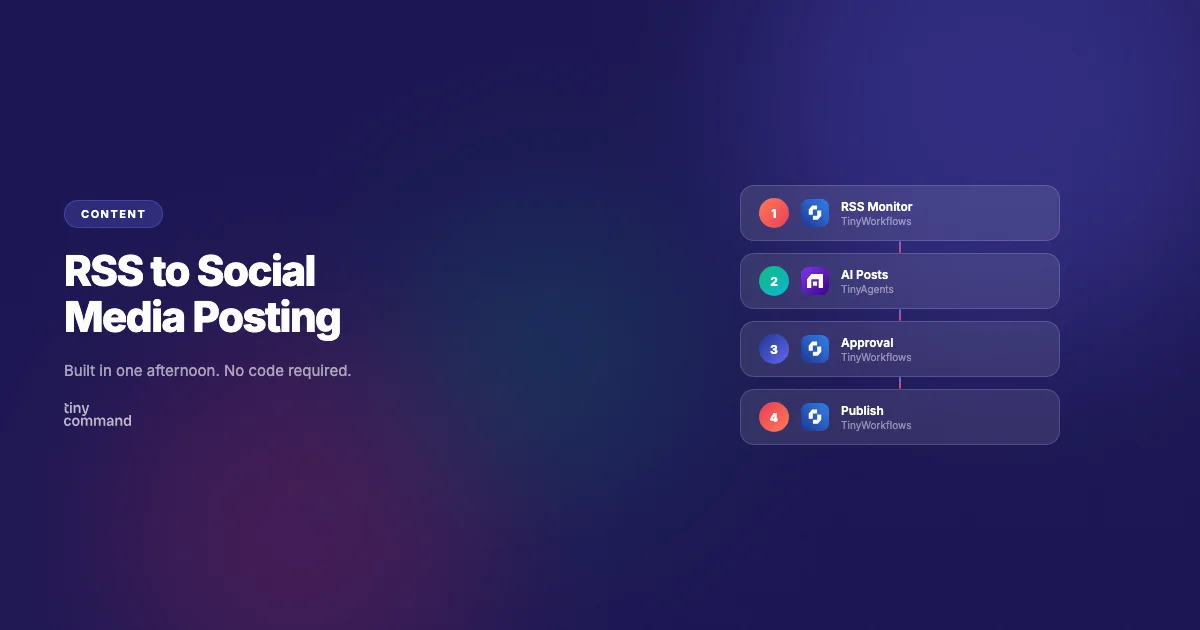
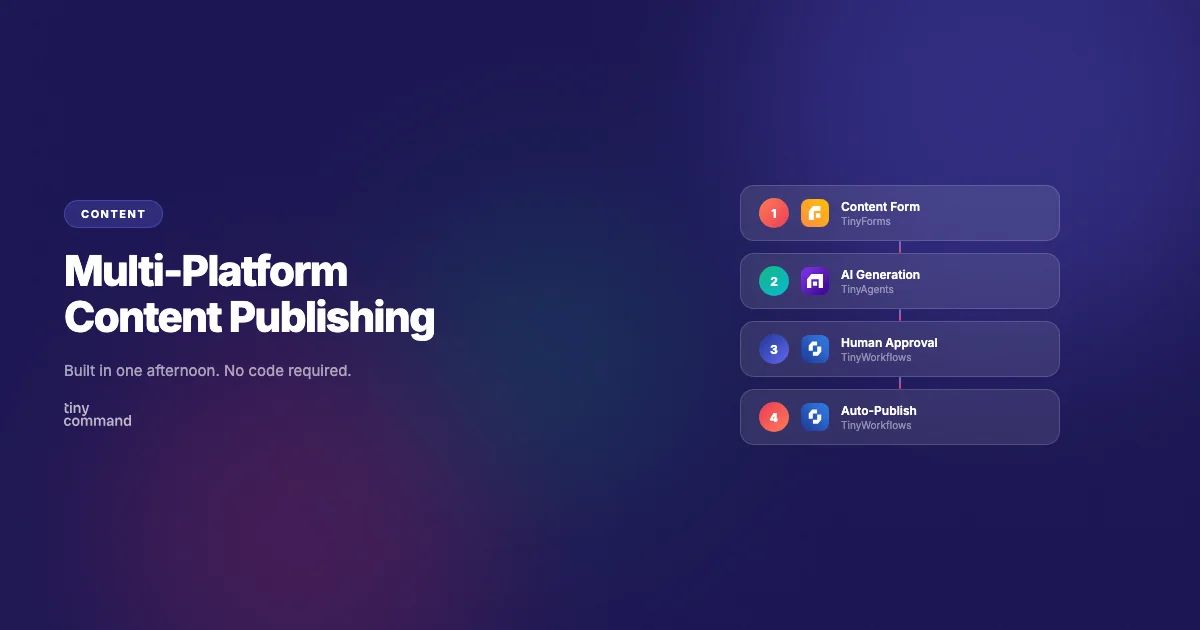
- Content generation at scale: Trigger a workflow with a topic and keywords → Claude writes a first draft → the draft is stored in TinyTables for review → approved content is published or emailed
- Data enrichment: A raw CSV is imported into TinyTables → Claude processes each row, extracting entities, standardizing formats, or generating summaries → enriched data is ready for outreach
- Email drafting with context: A customer replies to your email → Claude reads the thread, pulls relevant data from TinyTables, and drafts a contextual response → you review and send through Gmail
- Survey analysis: Hundreds of open-text survey responses land in TinyTables from TinyForms → Claude reads them all, identifies themes, and produces a summary report — in seconds, not hours
How the Claude integration works
TinyCommand connects to Anthropic's API directly. You provide your Anthropic API key once, and every workflow can use Claude as an action step.
Setup takes 2 minutes:
- Open a workflow in TinyWorkflows
- Add an "Anthropic Claude" action node
- Enter your Anthropic API key (get one at console.anthropic.com)
- Choose a model (Claude Opus, Sonnet, or Haiku)
- Write your prompt — use variables from previous workflow steps to make it dynamic
Claude's response becomes a workflow variable you can use in any subsequent step — send it as an email, store it in a database, post it to Slack, or pass it to another AI for a second opinion.
Which Claude model should you use?
Anthropic offers multiple Claude models. The right choice depends on your use case:
- Claude Opus — Most capable. Best for complex reasoning, nuanced writing, and multi-step analysis. Use for lead scoring, content generation, and detailed customer responses.
- Claude Sonnet — Balanced performance and speed. Best for most business automation: email drafting, data classification, summarization. The default choice for most workflows.
- Claude Haiku — Fastest and cheapest. Best for high-volume, simple tasks: sentiment classification, data extraction, yes/no routing decisions. Use when you process thousands of records.
You choose the model per workflow step. A single workflow can use Haiku for initial classification and Opus for the final customer-facing response.
Popular workflows with Claude
TinyForms → Claude → TinyEmails
Customer fills out a contact form. Claude reads the message, determines the intent, and drafts a personalized response. TinyEmails sends it. The customer gets a thoughtful reply in under a minute — no human in the loop.
TinyTables → Claude → TinyTables
Import a spreadsheet of raw leads. Claude processes each row: extracts company names from email domains, classifies industry, scores fit, and writes a one-line personalization note. The enriched table is ready for outreach.
Gmail → Claude → Slack
New email arrives. Claude reads it, determines urgency (low/medium/high) and category (sales/support/billing). Posts a formatted summary to the right Slack channel with recommended next action.
Webhook → Claude → Gmail
External system sends data via webhook (e.g., a failed payment from Stripe). Claude generates a customer-friendly explanation and recovery email. Gmail sends it. The customer gets help before they even contact support.
Connect Claude with your other tools
Claude is one of 93+ integrations on TinyCommand. The real power is combining Claude's intelligence with your other apps:
- Claude + Gmail: AI-drafted emails that sound like you wrote them
- Claude + Slack: Summarize long threads, classify messages, draft responses
- Claude + Google Sheets: Process spreadsheet data with AI — classify, extract, enrich
- Claude + HubSpot: Score leads and write personalized outreach based on CRM data
- Claude + Stripe: Generate customer communications around payment events
- Claude + TinyForms: Analyze survey responses and form submissions with AI
Claude vs other AI options on TinyCommand
TinyCommand supports multiple AI providers. Here is when to use Claude vs alternatives:
- Claude (Anthropic): Best for nuanced writing, careful reasoning, and tasks where tone matters. Strongest safety guardrails.
- OpenAI (GPT-4): Best for code generation, structured output, and function calling. Widest ecosystem.
- Gemini (Google): Best when you need Google ecosystem integration or multimodal (image + text) processing.
You are not locked in. Switch models per workflow step. Use Claude for customer-facing content and GPT-4 for data parsing in the same automation.
Frequently Asked Questions
Do I need my own Anthropic API key?
Yes. Create an account at console.anthropic.com and generate an API key. TinyCommand uses your key to call Claude's API directly. You pay Anthropic for token usage based on the model you choose.
What Claude models are supported?
All current Claude models: Opus (most capable), Sonnet (balanced), and Haiku (fastest/cheapest). You select the model per workflow step, so you can mix and match based on the task.
How much does it cost to use Claude in workflows?
Two costs: your TinyCommand plan (free to $149/mo) for workflow credits, and Anthropic's API pricing for Claude token usage. Haiku costs fractions of a cent per request. Sonnet and Opus cost more but deliver higher quality.
Can Claude read data from my TinyTables database?
Yes. In a workflow, you pull data from TinyTables in one step and pass it to Claude as context in the next step. Claude processes it and returns the result, which you can write back to TinyTables or send elsewhere.
Is my data sent to Anthropic secure?
TinyCommand sends your prompt and data to Anthropic's API over encrypted HTTPS. Anthropic does not use API data to train their models. Review Anthropic's data policy at anthropic.com/privacy for full details.